Steep Skiing in Colorado
Summit County Skiing Nearby Counties Skiing My Skiing Wish List More Ski Routes
2010 Spring Blog: Brief info on routes and roads from the current spring ski season.
(Photos and more details are in the route descriptions found by the links above.)
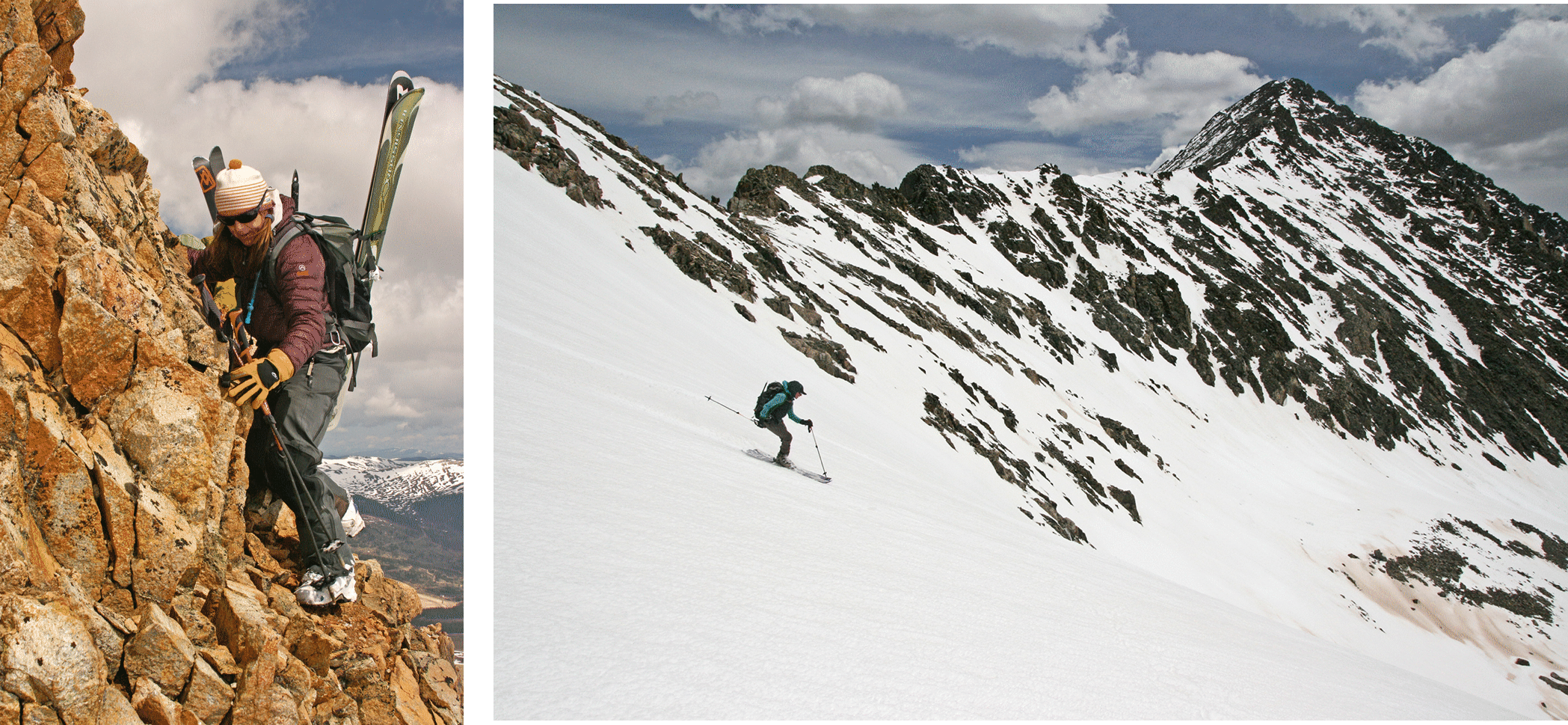
June 6. Chet Roe and I skied the large face on the south east side of Arkansas, facing the Arkansas River Valley. We had thought the crazy N-facing couloir might be doable, but it was not: rocks, runnels. So we circled around and booted up to the 13300 level in mushy but skiable snow. At the end I went up a steep rocky gully that I was familiar with from an exploration last summer, while Chet went over the vertical headwall/cornice. Both worked. One could call this line Louisiana since it is south of Arkansas. Matt Jones was with us but decided to wait at the bottom of the steep slope because of knee-related issues. I think this will mark the end of the season this year; it is just too unesthetic skiing in the snirt. But today was yet one more new line in a season where everything I skied, save one descent of Lakeview, was new for me. That is satisfying. Does anyone out there read these musings? I have no idea, but keeping such a diary is nonetheless useful and fun.
May 30. Chet Roe and I skied the obvious couloir on the NE face of Coon Hill. The ascent (boots all the way) was very quick from the west portal of the tunnel. The descent was in perfect condition: Steep, but soft; just right. Then we just climbed back via the Coon Hill - Golden Bear saddle, though one could climb back to the summit of Coon on the other side and ski down from there.
May 28. Kim McGranahan and I met at the Herman Gulch TH and tried for a line off the NW side of Pettingell that I had seen for several years from Buffalo summit. Actually, it seems that this side is pretty much west-facing. We headed left in mid-valley towards Snoopy (aka Citadel) and then back right so as to get to the Snoopy-Pettingell saddle. We left snow for grass-and-rock slopes, but it all went fine. Once on the ridge -- the Continental Divide -- we looked over to where I thought the line was to be, but there was only rocks. Slightly discouraged, we headed up Pettingell but quickly found a line on the Pacific Ocean side of the divide that looked like it would work. Skiing was very firm, despite the hot temperatures lower down. I side-slipped a ways but it was not a problem as the slope was not all that steep. This put us in the headwaters of the east branch of the Williams Fork River. Very scenic (except for the dust of course). Then the route back, around to the saddle just W of Hagar worked well, and we finished this 9-hour, 4300-foot day by descending a little on Hagar slopes and then climbing and contouring around to the Snoopy-Bethel saddle, and back down Herman Gulch. I'm on a roll as every line skied this year, except Lakeview, has been a new one for me.
May 25. Jonathan and I skied to the top of Peak 13010 (apparently known as Golden Bear Peak; just N of Trelease and W of Hagar) and skied a good line on the E Face. It was very firm, but with enough give to be quite enjoyable. And the forest snow held firm. Summitted 10 am. Back at the house by noon.
May 22. Jonathan and I went for Sniktau E Face. Ascent was easy; 90 minutes. But the face looked a little boring so we did the south face instead. That was quite firm, so not greatest skiing for me, though Jonathan did fine. Saw big white animals crossing the slope under us: Took me a moment to identify the running goats! The return to the bump above Loveland Pass was straightforward as far as terrain went, but the winds were howling. I had never been in such strong winds. I was knocked over once while skinning uphill, and Jonathan four times. The transition at the bump was nearly impossible. Back at the pass, only about 600 feet lower, people were in shorts and winds werre mild. I cannot say that the gusts were 100 mph, but it would not surprise me if they were (keeping in mind that at altitude wind has less mass (therefore higher speed for same "feel")).
May 20. Jonathan and I went to Jacque Peak above Copper to try for the NE shoulder route known as "Wilson's Rage". The entrance was a little tricky -- not impossible, but we decided to instead go to the summit and ski the SE face which was clean, long, and very white. That went well. The descent on Copper trails was ridiculously slow because of the new wet snow. Still a nice summit on a fine day. And no unpleasant interactions with Copper staff (a couple of years ago I was told that I was trespassing and to leave when skinning up after the area had closed).
May 19. Tour on light gear at Vail Pass in a snowstorm. Excellent conditions and coverage. Felt like winter. Went to top of Machinegun Ridge.
May 12. Back to it after two weeks in Escalante. Skied the east face of Little Bartlett with Jonathan Kriegel, Maggie Gaddis, and Elke Dratch. Conditions were quite good, though the dirt layers are worrisome.
April 21. A few solo runs at Loveland ski area. Conditions were pretty bad up high.
April 18. Buffalo Caldera from the summit, with Jonathan and Bob. Bit of a hairy day. The woods were the worst I've seen them: extremely rotten, though okay on ascent. The caldera below the cliff was fine. Getting through the cliff was a challenge as the route we thought we would take did not work. So we went to the far N end and had continuous snow through the cliff.
April 17. Light gear tour behind Arkansas. Some rotten snow.
April 14. Jonathan and I skied the Buffalo Caldera below the cliff. That is, we climbed to 12350 (400 ft below the summit) of Buffalo South and dropped in on very good north-facing snow to hit the caldera in the basin just below the giant cliff. The descent from there back to the car was excellent. Under four hours round-trip.
April 10. Jonathan Kriegel, Bob Portmann, and I climbed and skied Lakeview on Buffalo. Ascent went very well. Car-to-car skiing of course. Upper section of descent was crusty but it steadily improved. There was evidence of recent dust blow-in from the west. Hard to predict how bad it will be later as the surface melts.
March 19-22. Jonathan Kriegel and I camped in the LaSals and skied the S Face of Haystack, N Face of Mellenthin, W side of Tomasaki, and W side of Burro Ridge. Details in LaSals link on my main page.
Route List: Graded according to difficulty
Some of the routes on this site are mellow, and a skilled intermediate skier would feel confident skiing alone on them, while others are quite steep and, in unfavorable conditions, potentially dangerous. But all ratings go out the window in the face of weather and snow conditions. Avalanches seem like a minor concern this time of year (but in certain conditions avalanches can be as dangerous and potentially deadly in spring as well as winter, May 2005 being a notorious example). Still, in my experience the risk of taking a fall on an icy slope and going for a long ride is more serious.
Speaking of avalanches, I have never been in one of any size in Colorado, but have been involved in several in British Columbia, which are reported on elsewhere (e.g., Olive Hut and Icefall Lodge reports).
Here is a summary of the ski lines. All of these offer excellent skiing in a scenic mountain environment. If you have comments on any of these lines, or interesting photos, I'd be pleased to add them to this site. And some of my names are provisional: we'll see if they catch on. Some do, some don't.
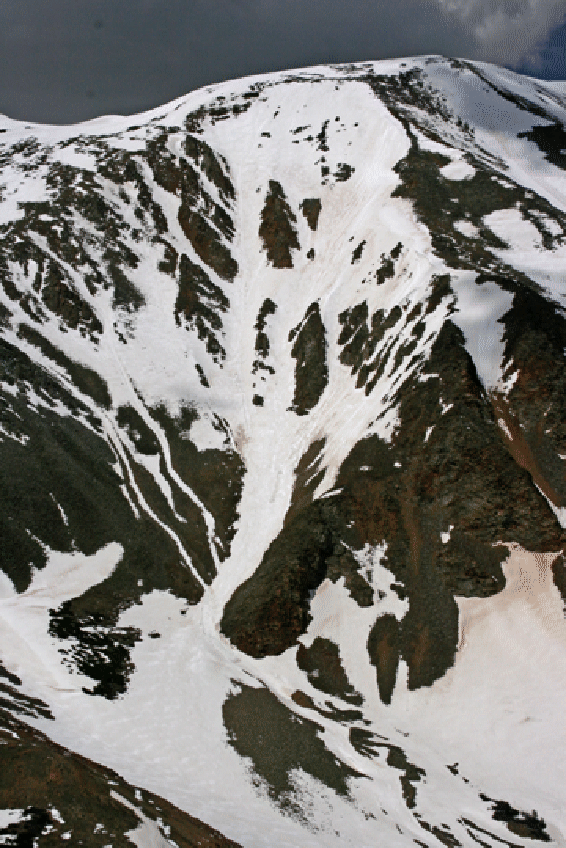
Steep (I would rate all these at least D9 (see <<http://wildsnow.com/articles/ratings/ski-board-d-rating-system.html>>) which, to quote Lou Dawson on D10, means: "Slopes probably around 45 degrees, with a few complicating terrain features. This is the spot on the scale where true extreme skiing begins."
Meshuggeneh (a crazy line on the peak NW along the ridge from Wheeler; not done by me); D14.
Clinton, North Face Couloirs (aka, The Big Guy; not done by me); D13
Drift (sustained steepness for a long way, great curb appeal from Highway 91; viewed from Shrine Pass it stands out spectacularly and dominates this view of the west side of the Ten Mile Range); D12
East East Red, What Big Eyes You Have (a very narrow, steep, and deeply cut couloir; skied first by Dave Bourassa (not by me)); D11
Peak C (an amazing summit to get to with skis, offering a steep face and then a narrow couloir); D11
Deming Drop (rarely skied, somewhat narrow couloir ending in a remote and pristine valley; easily seen from Red Buffalo Pass); D10
La Plata (looks amazing when viewed from a distance); D10 for the eastern of the two commonly skied runs, D11 for the western (not skied by me).
Red Peak, Big Bad Wolf; D10
Quandary Cristo Couloir (notorious and crowded); D10
Buffalo Caldera (hard to rate: the skiing is not generally difficult, but there is lots of objective danger); D9 or 10
Democrat N Face (classic: steep and long; one of the best in Summit County area; easy access); D9
Sayers, X Rated (2000 feet of north-facing skiing in a superb alpine setting; D13 for the steep entrance near the summit (not skied by me), D10 for the entrance about 100 yards to the east).
Crystal N Chutes (tough climb back to the saddle to the east, but car shuttle to Rte 91 works too); D9
Peak Z (camping out is best; very remote, despite being visible from City Market in Dillon; steep); D9
Moderate (D6 to D8)
Buffalo North Couloir (very, very popular); D8
Grizzly Chute on Grizzly Peak (Independence Pass area); D8 (my rating; Dawson rates D9)
Rain, Graupel Gully; D8
Edwards, N Couloir (hard to enter; can by icy at top); D8
Clinton, Monica's Descent (pretty valley approach; classic couloir); D8
Buckskin, S Face (the Fringe); D8
Bartlett, N Face; D7
Keller Kelloir, the couloir immediately west of subsummiit 12847; D7; not skied by me.
Sayres, Grand Central Couloir (high peak SW of La Plata; beautiful line; high and north; worth the effort); D7
Ribbon on Grays (not skiable every year; grab it when you can); D7
Torreys, Tuning Forks; D7
Mt Mellenthin N Face, La Sal Range near Moab, Utah; D7.
Arkansas, Northwest Face (short approach, very steep at top, some rocks); D7
Coon Hill, Northeast couloir; D7
Pettengell, Northwest Face; D6 or D7 for the line I skied, which is a few minutes E of the Pettengell-Citadel saddle
East East Red, Little Red Riding Hood (great curb appeal, as this is fully visible from road north of Silverthorne); D6
Guyot, Swan Dive; D6
Ruby, East Face (It's Greek to Me); D6
Baldy (Breckenridge) Chutes; D6 for either of the two main chutes. D5 or 6 for the various other ways down north along the ridge.
Argentine, East Face Couloir, the southernmost one from the summit ridge; D6.
Sniktau, South Face from the summit; D6.
Easy (D4–D5)
Mosquito, north side (very short approach); D6 because of rocks and steepness at the upper end.
Democrat, South Face (perhaps neglected, but a very fast way to descend this popular 14er); D5
Keller Kelloir, the face from a flat area 100 yards or so west of subsummiit 12847; D5
Baldy, Orion; D5
Crystal, South Face (fine views of Pacific, and Crystal N Chutes); D5
Pacific Peak (one of the nicest summits around; via McCullough Gulch (D5) or Hawaii Couloirs in Spruce Creek (D6))
Horseshoe face on Grays (a back way to a popular summit; a short day when one can drive to the road end); D5
Northwest Passage on Atlantic (great easy and fun line from a high summit; in a beautiful valley; western couloir is harder); D4
Red, South Face (my backyard; via SW face towards Red Buffalo Pass (D4), or the steeper line in SE direction (D5))
Grizzly, NW face (near A-Basin); D5
Arkansas, Southeast Face (Louisiana): D5
Buffalo Lakeview (easy access; not too steep; I've soloed it twice); D4
Buckskin, North Face (great views of Democrat; very short approach); D4
Bard Peak, Shakespeare (2300 feet on a consistent 30-35 degree face); D4
Pettingell, South Face (1800 feet of skiing in the 35-degree range; easy access); D4
Mt Bross, Serpentine Gully on west face; D4
Traver, SE Face (2000 feet of skiing starting at 13865); D4
Coon Hill, SE Face (easy access from Eisenhower Tunnel); D4
Little Bartlett, E Face; D4
Buffalo, Golden Couloir; D3
Massive, East Face (can be good in late season); D3
Peak 13010 (Golden Bear Peak, near Hagar), E Face; D3
Jacque Peak, SE Face; D3 or D2
Dawson's suggested grading system also includes a Route Length Grade, analogous to what has been used in mountaineering for years. In that scale Grade II is a half-day, Grade III is a normal day, Grade IV is the longest that is done without overnight. On that scale most of the things on this web page are II or III. Let me mention some that are IVs, meaning that you should definitely plan on a very full day: Sayres, Peak C, Peak Z, La Plata, Red Peak North Side.
In the mid 1990s, when I was told that some people preferred the skiing in June to that in mid-winter, I did not understand. Then I started skiing the steep spring routes. Now I understand!
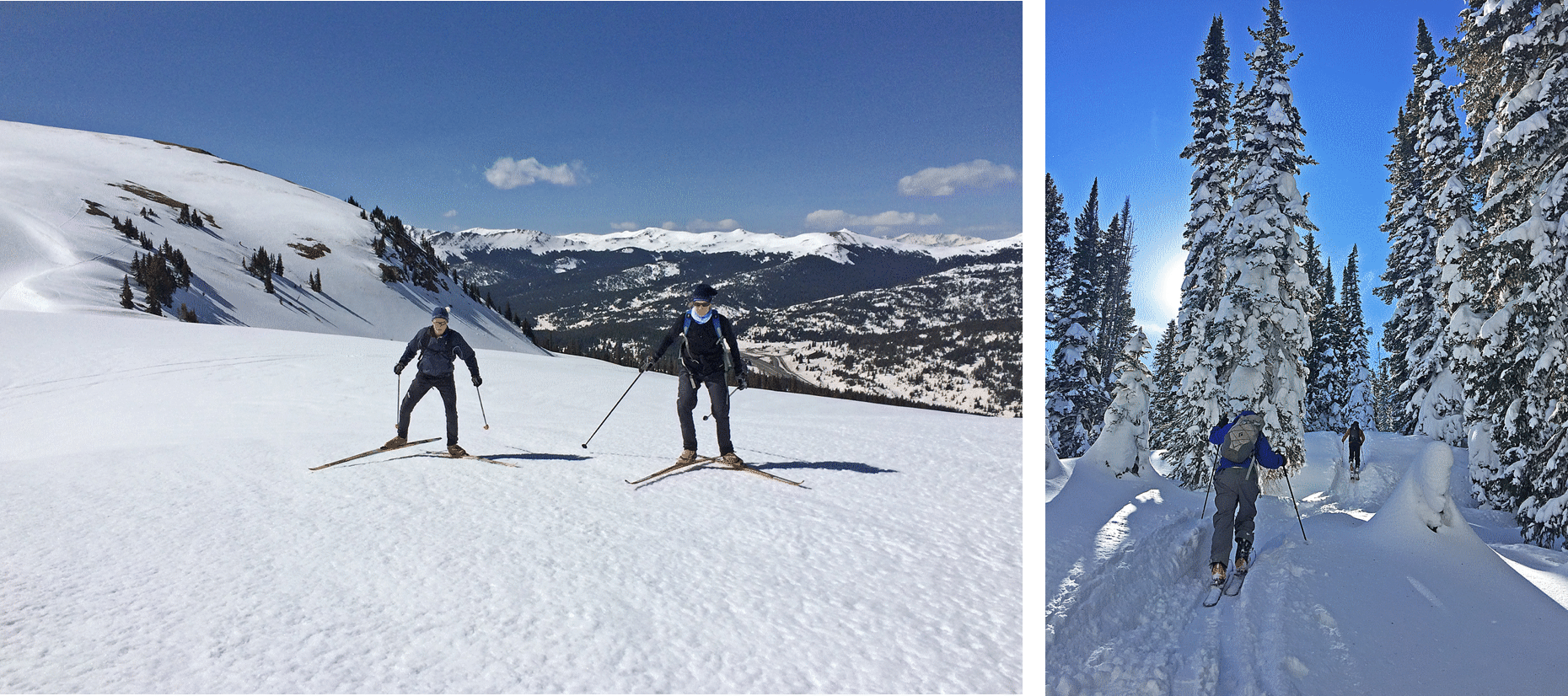
There are lots of reasons to be enthusiastic about spring skiing. Sure, there are the steep lines that are generally safe. But the whole package is what makes this time of year so great. Often one can ski from a summit back to the car in very short order. Cruising on the gentle terrain around rocks, frozen streams, willows, and ptarmigan is a blast. On the other hand, one does sometimes have to carry skis and boots over wet ground or through thick forests. Well, days like that just make the time spent up high even more special.
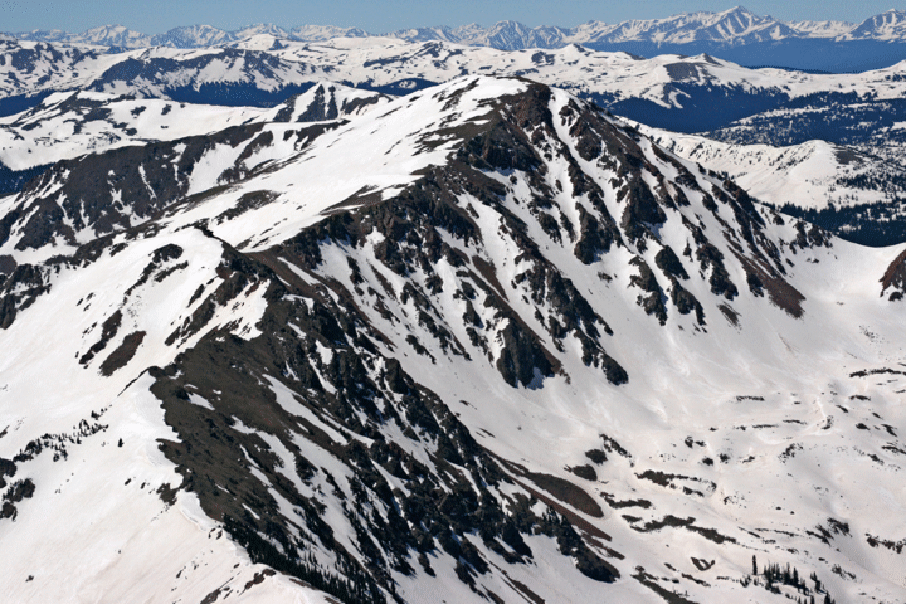
The links above give photos and descriptions of routes that are best in May, June, and sometimes July or April. Almost all of these are in sight of the towns of Frisco or Silverthorne, though of course I have ventured farther afield towards Leadville and Vail. All of these photos are very striking in a large print, and I can provide such prints on request. I have taken a lot of trouble to get directly opposite the ski lines; it is worth it, as I think the photos of the Ribbon, the Deming Drop, the Zebra Stripes, Sayers, La Plata, Big Eyes, Democrat, and the Tuning Fork show.
Ratings: There is a rating list above; I have not included ratings with the descriptions. If you feel some ratings need adjustment, do tell.